
Georgia Democrats have historically done a good job of registering voters and a lousy job of getting them to the polls. On this past Tuesday, they did a much better job on the second part.
The drubbing of two incumbent Republican Public Service Commission members, Tim Echols and Fitz Johnson, was by any measure historic. Their two Democratic challengers, Alicia Johnson and Peter Hubbard, racked up better than 60-40 victories in the statewide races. Democrat Johnson beat Echols 978,548 to 581,927, according to the latest vote counts from Georgia Secretary of State Brad Raffensperger’s office. Hubbard did slightly better in his thrashing of the Republican Johnson, winning 980,265 to 577,980.
The Democratic wins were a little slow to bubble into Tuesday night’s cable TV coverage of higher-profile races, but they were very much a part of the national story of a Democratic sweep that included the election of governors in New Jersey and Virginia, the election of a self-styled Democratic socialist as mayor of New York City, and the passage of Proposition 50 in California, which clears the way for Democrats in that state to snare several more congressional seats in response to a plan by Texas Republicans to do the same thing in their state.

In some ways, the Georgia victories may be even more important than the higher-profile races. Especially in combination with Democratic wins in three state legislative elections in Mississippi, they offer a bit of evidence that the Democratic Party might still have a pulse in the Deep South. It is, of course, possible to read too much into the results of a single off-year election, but a quick dive into Tuesday’s election results suggests that there are takeaways that might well apply to the looming 2026 elections (and perhaps beyond).
Herewith, TIGC’s first crack at those takeaways:
Without Trump on the ballot, MAGA voters sat home in droves. This flips the story from 2024. In that presidential election, Republican-dominated counties outperformed their Democratic counterparts overwhelmingly and handed Donald J. Trump a 115,000-vote victory over Kamala Harris. Tuesday night was the opposite. The 27 Georgia counties that sided with Harris in 2024 sent 23.6 percent of their active voters to the polls in this year’s election, versus just 18.0 percent in the 132 Trump counties.

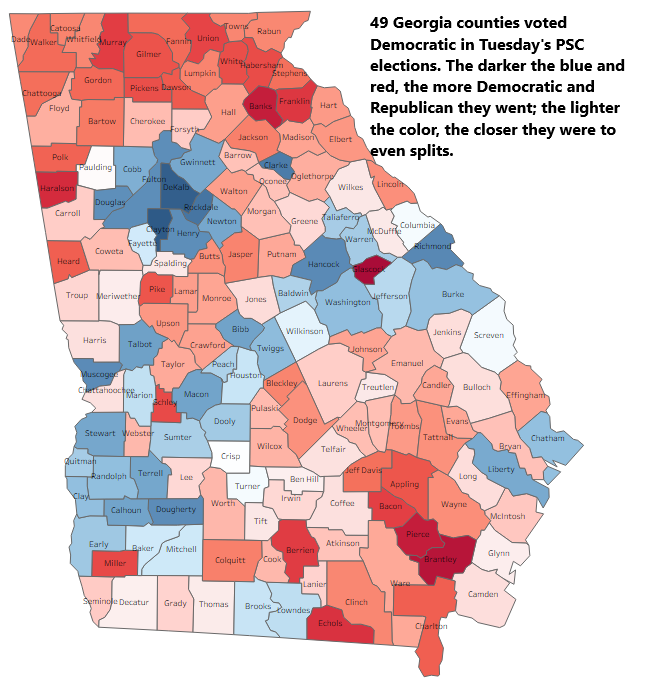
For the moment, nearly all of Georgia tilted to the left. Only two of the state’s 159 went more Republican this year than they did in the 2024 presidential election — Miller County (2.7% more Republican) and Webster County (1.2%). Of the other 157 counties, 90 shifted at least 10 points more Democratic. In the biggest shift, Twiggs County, which went 57%-to-43% for Trump last year, whipsawed 24.8 points to the left this year and gave the Democratic PSC nominees 67%-to-33% victories.
Size mattered: on Tuesday, Metro Atlanta swamped rural Georgia. Just over one million of the total 1.56 million votes cast in Tuesday’s election were cast in the 29-county Atlanta Metropolitan Statistical Area (MSA). The 99 Georgia counties with populations of less than 20,000 contributed just 12 percent of the total vote on Tuesday. DeKalb and Fulton counties led the turnout parade, with turnout rates (calculated against the total number of active voters) of 29.8 and 29.3 percent, respectively. Combined, they gave the Democrats 5-to-1 victories and more than half their total votes.
Twenty-two counties that went for Trump in 2024 voted Democratic on Tuesday. All told, 49 of Georgia’s 159 counties sided with the Democratic candidates, a high-water mark in recent cycles, and that gave the party an unbroken string of blue counties across the belly of the state. Among the traditionally GOP counties that flipped were Columbia County, a white flight county north of Augusta, and Lowndes County (Valdosta) down on the Florida line.
All that said, many major Democratic strongholds continue to underperform. Among the major Democratic counties that continued to lag Metro Atlanta and the statewide average were Macon-Bibb (17.5%), Clayton (18.5%), Dougherty (18.2%), Columbus-Muscogee (15.2%), and Augusta-Richmond (17.0%). That poor performance was offset by equally tepid turnout in such reliable GOP counties as Forsyth (17.7%), Glynn (16.7%) and Whitfield (14.3%).
What, if anything, does all this mean for 2026?
It’s a clear shot in the arm for dispirited Georgia Democrats looking to re-elect U.S. Senator Jon Ossoff and reclaim a governor’s office that has been owned for the past quarter-century by Republicans. Tuesday night’s results owed largely to a combination of Democratic fury at all things Trump and Republican/MAGA apathy born of Trump’s absence from the ballot and perhaps some disappointment in his performance to date. How much of that will carry forward over the next 12 months remains to be seen, of course.
But a couple of aspects of the 2026 races have now snapped into sharper focus. For the Georgia Democratic Party, one critical task is to figure out how to replicate the turnout it achieved in Fulton and DeKalb (with Cobb, Gwinnett and Rockdale not far behind) in other major urban centers around the state. If Blue Georgia can consistently match Red Georgia in voter turnout, it’ll be game over for a while.
For the Republicans, job one will be to figure out whether a Trump endorsement is a blessing or a burden. Lt. Governor Burt Jones, an avowed MAGA acolyte who already has Trump’s backing to be Georgia’s next governor, currently leads the GOP field with the backing of 22 percent of Republican voters, according to a recent AJC poll. But just seven points behind him is Secretary of State Raffensperger, who famously refused to go along with Trump’s demand that he find the extra 11,800 votes Trump needed to win Georgia in 2020. Perhaps most significantly, 55 percent of GOP voters told the AJC pollsters they were undecided.




Leave a Reply